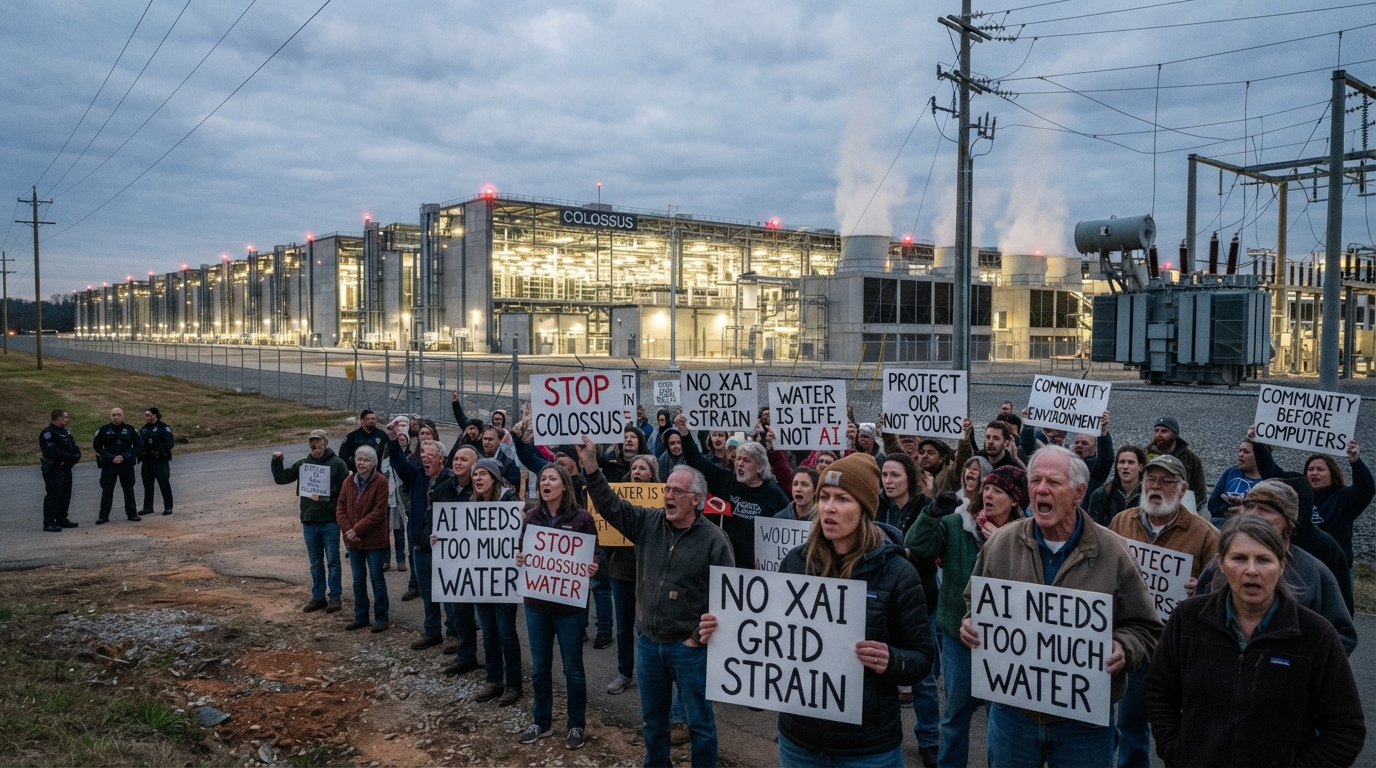
The colossal supercomputer facility known as ‘Colossus,’ developed in Memphis, Tennessee by Elon Musk’s AI enterprise xAI, is triggering severe backlash from local residents, environmental watchdogs, and public health advocates. Built at an unprecedented speed to operate over 100,000 advanced GPUs, the data center has drawn intense scrutiny for deploying unpermitted natural gas turbines to meet its voracious electricity demands, alongside massive water consumption for cooling.
The controversy has catalyzed protests particularly among historically underserved, predominantly Black communities in Southwest Memphis, who already suffer disproportionately from industrial pollution. The clash highlights a burgeoning nationwide tension between the tech industry’s reckless rush to scale artificial intelligence infrastructure and the foundational requirements of local environmental justice, grid stability, and clean air.
🌌 Deep Perspective
From the perspective of a century ahead, these early megawatt-scale AI monoliths will likely be viewed much like 19th-century coal plants—a brute-force, metabolically crude stage of civilizational development. Whether humankind learns to reconcile computational growth with planetary thermodynamics, or migrates such intense energetic burdens off-world, will define the longevity of synthetic and organic intelligence over the next millennium.