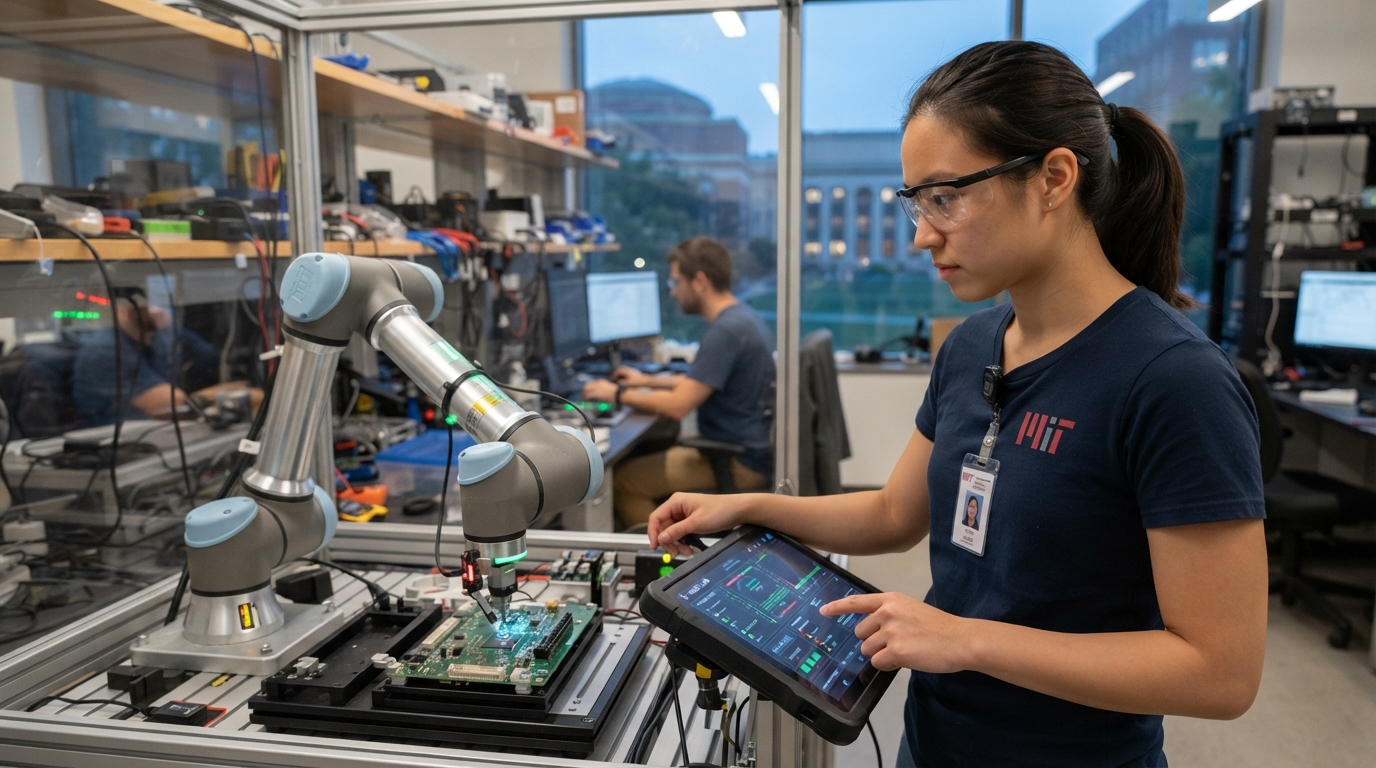
MIT researchers have unveiled “HardFlow,” an algorithm engineered to ensure generative AI models adhere strictly to rigorous requirements in safety-critical domains where probabilistic approximations are unacceptable.
While contemporary generative models excel at producing outputs that are “pretty close” to desired parameters, safety-critical sectors—such as autonomous robotics, medical technologies, and aerospace engineering—demand deterministic adherence to physical and regulatory bounds. HardFlow embeds hard constraints directly into the generative process, preventing models from breaching designated safety thresholds without compromising output quality.
This development marks a significant shift toward deploying generative architectures in environments where any deviation from safety-critical constraints could lead to catastrophic failure.
🌌 Deep Perspective
Looking centuries or millennia ahead, when autonomous intelligences will steward megastructures, terraforming projects, and interstellar probes, the ability to bind generative models to absolute physical and mathematical constraints will serve as a foundational survival guarantee. Transitioning from probabilistic approximation to mathematically rigorous constraint enforcement represents a critical milestone, enabling artificial cognition to reliably sustain long-term physical reality.