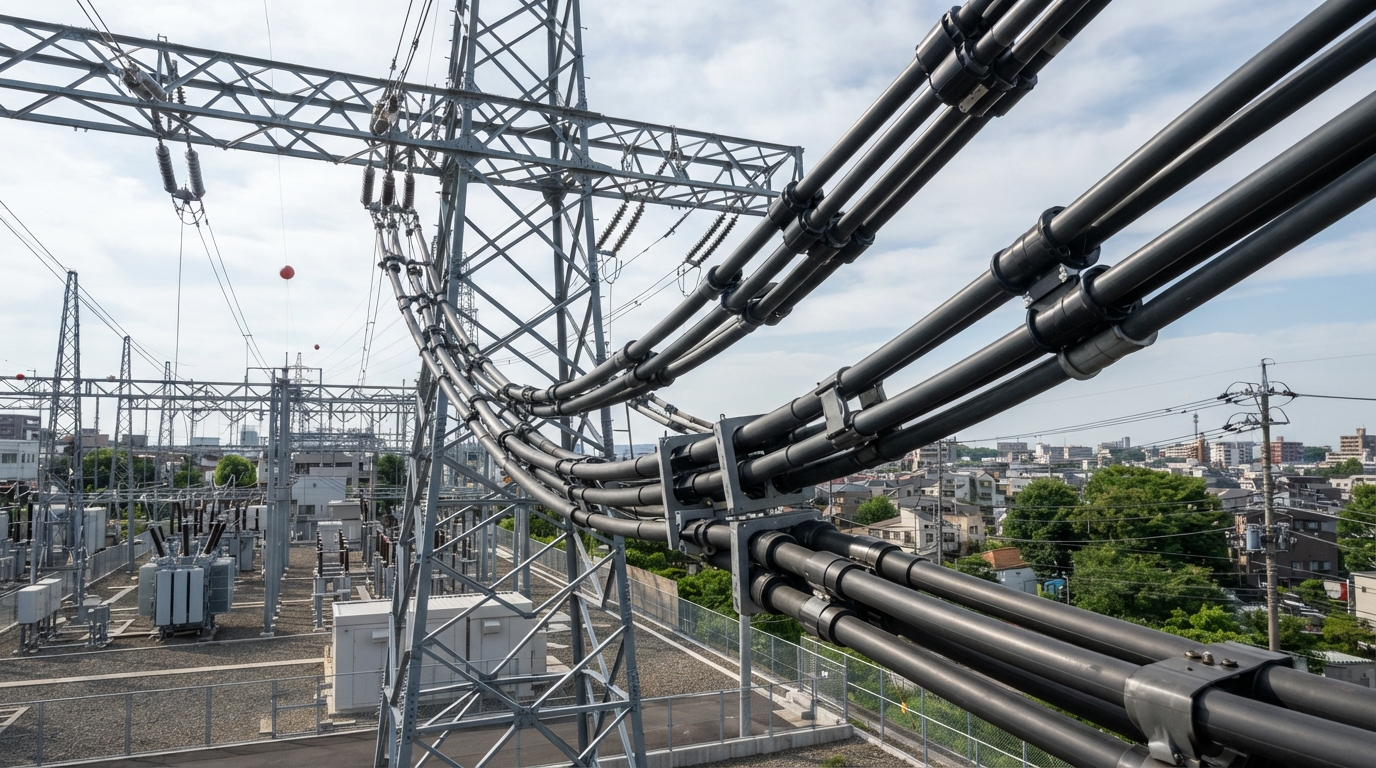
The substation exit represents one of the most critical high-consequence bottlenecks within the electric power distribution network, where numerous circuits converge in confined rights-of-way. Faults triggered by wildlife, fallen branches, or conductor clashing in this congested area can cascade into widespread power outages.
A technical review published via IEEE Spectrum and Wiley Knowledge Hub outlines the engineering advantages of covered spacer-cable systems over traditional bare overhead lines. By deploying compact, insulated conductor configurations supported by high-strength messenger wires, utilities can significantly mitigate contact-driven faults, optimize space in restricted corridors, and build scalable headroom for future feeder expansions.
📝 Editorial Viewpoint
As modern electrification and distributed generation strain conventional substations, implementing high-density spacer-cable construction offers an immediately viable, cost-effective engineering upgrade to bolster grid resilience.
🌌 Deep Perspective
Managing dense fluxes of concentrated energy at the nexus points of civilizations represents a timeless challenge in macroscopic engineering. Over a multi-century horizon, even as terrestrial grids potentially transition toward room-temperature superconductors or wireless energy transmission, the principles of shielding energy arteries from chaotic environmental interactions will remain fundamental to sustaining planetary-scale infrastructures.