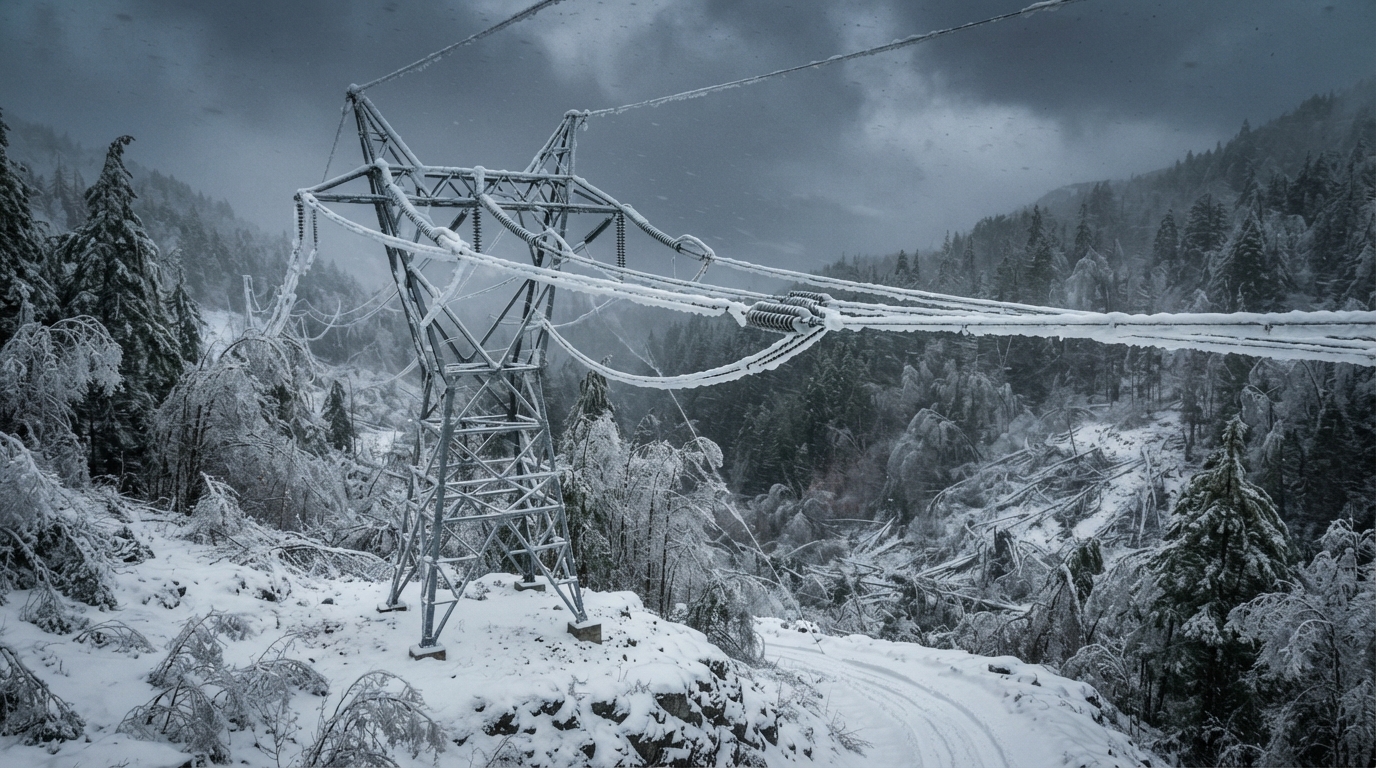
As extreme winter storms intensify due to shifting climatic patterns, strengthening the physical resilience of overhead power distribution lines has become a critical engineering priority. Technical guidance from IEEE Spectrum and Wiley Knowledge Hub examines how simultaneous mechanical stressors—specifically ice accretion, severe wind, freezing rain, and encroaching vegetation—interact and impose severe simultaneous loads on overhead distribution infrastructure.
Traditional design practices have often analyzed wind speed and ice accretion as isolated or statically simplified parameters. However, in severe winter events, ice buildup drastically alters the aerodynamic profile of conductors, triggering high-amplitude galloping and mechanical fatigue while falling trees and branches cause catastrophic multi-point failures. This technical focus emphasizes the necessity of concurrent multi-hazard dynamic modeling to optimize line tension, pole and tower structural integrity, and predictive vegetation management strategies.
📝 Editorial Viewpoint
Conventional safety margins calculated on single isolated metrics are no longer viable in an era of heightened atmospheric volatility; adopting integrated, compound-load modeling is vital for safeguarding modern grid reliability.
🌌 Deep Perspective
In the deep-time span of centuries and millennia, overhead open-air conductive wires will likely be remembered as a transitional artifact of early industrial civilization before the widespread adoption of deeply buried super-grids, localized microgrids, or wireless energy transmission. The persistent engineering battle against atmospheric forces underscores humanity’s ongoing evolutionary challenge to decouple foundational technological life-support systems from surface climatic vulnerability.